The Urban Escape, Part II

This is a continuation. Story starts here.

The man is already striding towards me, one hand up and waving back and forth, as if there’s any chance I would miss him.  “Barry!  Yoohoo!  Hey, what’s happening, mister early lunch?”

I feel my hands tense, clenching.  No.  Stay calm.  I can handle Gossip Gary.

“Oh, just feeling a little under the weather,” I reply quickly, stepping forward to cut the distance between us.  The man’s still loud, but maybe this will bring him from deafening down to just piercing.  “Think I might work from home this afternoon.”

“Under the weather?  I don’t see any rain clouds over ya!”  This is accompanied with a braying guffaw.  I want to knock his throat in.  No, stay calm, keep it cool.  Think sick thoughts.

Shrug.  “Well, you know there’s a bug going around,” I say.  I need to throw this dog off my scent.  A thought occurs, a possible way out.  “I mean, you heard about the ebola, didn’t you?”

“Oh, sure, I heard all about it!  What exactly are you talking about?”  He has no idea.  He can’t admit ignorance, however.  He’s hooked.

Lower my voice.  Look conspiratorial.  Play this right.  “It’s all over Africa, you know,” I let on.  “Spreading around.  Even the doctors are sick – and they’re coming back here!  Bringing it with them!  There might be an epidemic here, but all the news outlets want to keep it quiet!”

Oh, there’s the light in his eyes.  “But don’t tell anyone about it,” I go on.  Hook is set; time to reel in.  “We don’t want a panic, right?  People rushing the stores, riots, all of that.”  Tap nose.  Too much?  Nah, just enough.  “Know what I mean?”

The man is nodding – too fast.  He is caught, snared in my net.  Hook?  Net?  Whatever, I don’t fish.  He’s already itching to dash off and spread the news.  “Remember, keep it quiet, Gary,” I add, and then move past him.

I don’t think he even notices me leaving.

One down, and the exit’s ahead.  Go, go, go!  I put on a burst of speed.  One turn.  Two turns.  Just one more…

“Oh, Barry.  It’s terrible, isn’t it?”

Oh no…

To be continued!

The Urban Escape, Part I

Author’s note: Consider this a replacement for Monday’s lack of a post.  More to come tomorrow!

Ugh.  I can’t stand this any more.  I have just got to get out of here.

Sure, it was nice when I first took the job.  Decent pay, a cushy office chair, a cubicle of my own to decorate with pictures of all those places I hope to someday be able to afford to go, and a computer with unfettered internet access.  What could be better?

Fast forward a couple of months, now, and that’s all gone sour.  The pay never lasts as long as I want, my chair makes a super annoying squeaking sound, my cubicle feels more like a prison cell, and my computer faces the entrance.  I go on a site not related to the company, and anyone who walks by my office can see it.

And oh, those people.  My god.

You know what?  I’m taking a half day.  I’ve decided, just now.  Feel that chill in the air?  No?  Maybe it’s just me.  My throat is just really scratchy today.  Ugh, I just feel like I need to cough, but I don’t, you know what I mean?

Yep, definitely getting out of here early.

Computer’s shut down.  Files in briefcase, so I can claim to be “getting work done from home while recovering.”  Hah, like that’s gonna happen.  Coat.  Keys.  Make sure little African Violet plant has enough water.  Check.

Now, for the escape…

Peek out the cubicle.  Left.  Right.  Okay, coast is clear.  Time to move. Remember, keep low.  The walls are low enough so that I’ll be spotted if I straighten up.  Keep my back bent, head down like a good drone, and I’m invisible.  Coming up on the corner.  Turn left-

“Oh, Barry!  Where you headed?  Getting lunch already – it’s a bit early, isn’t it?  Are you meeting someone?  Who is it?”

Crap.

To be continued…

On building an airship

I have recently decided that I want an airship.

If you have seen Up, you know what I’m talking about.  The idea of a powered lighter-than-air transport device allowing for leisurely exploration, equipped with a full cabin and living quarters is incredibly freeing.  To be able to roam the Earth above the clouds, descending wherever you choose to land, reaching places untouched by any other vehicle… the idea sounds incredible.

Unfortunately, it’s pretty much still only in the realm of fantasy – or perhaps possible for a crazed billionaire like Sir Richard Branson.

The single biggest issue with an airship is the most obvious – getting it off the ground.  Currently there are two options, neither of which is especially appealing:

1. Hot air.  This is how hot air balloons work.  It’s cheap, which is great.  On the downside, hot air (at least, in balloons) lifts about 0.3 ounces per cubic foot.  That’s not a lot.  Just to lift me would take 6,500 cubic feet of hot air.  Add in the carriage, heater, propulsion source, and, not insignificantly, the actual containment bag, and we’re talking about an incredibly massive apparatus.  I’d like for my airship to be smaller than the city I park it over.

2. Helium.  Currently, this is how airships like the Goodyear blimp get off the ground.  And it has much more lifting power than hot air, at nearly an ounce per cubic foot.  So you only need 1/3 the bag size as using hot air.  But the caveat with helium is price: about $0.60 per cubic foot.  Now, that’s not too bad for birthday balloons.  But for two 150-lb people and a 200-lb structure, we’re talking nearly $3 grand in helium costs.  And that isn’t a one-time purchase; helium dissipates, and the dirigible must be refilled every now and then.

There is one more option that isn’t on here: hydrogen.  Hydrogen provides about 7% more lift than helium, but it is also very, very explosive.  Hindenburg ring any bells?  In addition, hydrogen airships are illegal in many countries, simply due to the ever-present risk of danger.  There’s also a wide range of concentrations where hydrogen is still very flammable, which means even mixing it with air doesn’t do the trick of preventing your airship from disappearing in a very loud “bang.”

So for lift, I’m currently going with helium, but it’s not a great solution.  But let’s put a pin in that for now and turn to the other side of the coin: weight.

Humans are fairly dense.  Food is heavy.  Fuel is heavy.  And engines are heavy.  All of these things need to somehow get up in the air, which means a lot of lift.  Fortunately, in this area there are a few useful innovations that could be beneficial.

#1: Aerogel.  This substance is basically a gel, but instead of containing liquid between the matrix of solid molecules, it contains air.  Very expensive to make (currently more expensive per volume than gold), but it is also incredibly light.  And unlike “gel” suggests, it’s quite solid and durable.  Building many of the airship structural parts out of aerogel, especially internal struts and supports, could help drastically reduce the weight.

#2: Stirling engines.  These are engines that run based on a temperature differential.  For example, they can run when placed on a hot surface in a cooler environment.  And given the fact that hot air is providing lift on its own, using that heat for propulsion would be a great idea as well.  Perhaps most important with a Stirling engine is that, because its “fuel” is the temperature differential, there’s no need to carry around heavy, flammable liquids like gasoline.

One option that uses Stirling engines is to have a black airship; in the day, the sun would heat up the interior of the structure, creating a temperature gradient to power the Stirling engines.  Of course, this would be fairly ineffective on cold days or at night, but it would help lessen other fuel demands.

#3: Carbon fiber.  Carbon fiber seems to be everywhere now (I can buy a carbon fiber wallet and clipboard online now, if I had any inclination to do so), but it is a very useful material.  Incredibly strong and quite light, this would be ideal for the structure of the airship and cabin.  Synthesizing it is expensive, of course, but costs are constantly dropping, further aided by the use of 3D printers.  A question to consider: could a Stirling engine be build mainly of carbon fiber parts?

Unfortunately, lightening the load only goes so far.  Even if the structure was weightless, there’s still the weight of people, cargo, food, and so on.  We’re still talking about a couple thousand cubic feet of substance for lift.  So until a better method of achieving lift is discovered, this will be a frustrating concept.

Still, the end result is incredibly appealing.  What a retirement that would be…

The (Lack of) Glamour of Air Travel

Similar to riding horses, shopping in Abercrombie and Fitch, and playing craps at a casino, traveling by air is one of those activities that always seems glamorous and fancy up until you actually do it.  Hold on a minute, scratch that.  I’ve played craps before and it’s quite enjoyable.  Replace that with taking a taxi.

I have performed all of these activities, and one of their most striking qualities is how much less fun they were to do than they seemed from afar.  As a graduate student living halfway across the country from the rest of my family, I find myself at the unfortunate intersection of “needing to fly regularly” and “I’m poor and need to take three flights at 1:30 AM”.  And this is not a fun intersection to be stranded at.

But traveling via airplane is an interesting combination of wonder and utter frustration.  The indignity and bother of removing every single object from my person at security screenings?  The incredibly overpriced and meager selection of food for sale in airports?  The disturbingly squishy chairs that somehow can never be comfortable for more than five minutes?  The stale, dry, dirty air on the planes themselves?  All of these little frustrations come together to make traveling by air a rather unpleasant experience.

On the other hand, I can never quite shake that sense of wonder I feel as the plane finally lifts off from the runway.  Wilbur and Orville Wright flew for the very first time in 1906 (I know that off the top of my head – be impressed), and now, barely over a hundred years later, we clamber fearlessly into metal tubes that streak across the sky, higher than we can breathe, propelled by the constant combustion of incredibly flammable liquids.

Flight is a marvel, something that humanity has strived to attain for thousands of years.  And yet, today we treat it as an inconvenience!  What plasticity the human mind possesses, to shift its mindset so radically in just a few generations.

But I’m a scientist, not a philosopher, so I’m going to brainstorm a few ways that we could shake off a few of the annoyances associated about airplanes:

1. Security checkpoints are long and annoying.  We may have switched over to millimeter wave detection, but why in the world do we still need to take off our shoes and empty our pockets?  Let’s get some automated smart scanners that generate a three-dimensional scan and identify weapons, combined with chemical sniffers that can detect single molecules of explosive.  And to be honest, I don’t really care if some balding TSA agent happens to see my outline beneath my clothes – more incentive for me to stay in shape!

2. The single most infuriating thing about air travel, in my opinion, is the waiting.  Oh god, so much waiting.  I’m sure that most airlines have very complicated computer algorithms to determine when and where flights take off from and are destined to land, but let’s take it a step further.  When I check in, I want to be sent an electronic boarding pass with a QR code and a date and time.  I want to know that, at that specific time, I can walk straight onto the airplane.  We’re already getting close with zone boarding, just put everything on a timetable!  You’ll know exactly when you need to be at the airport, and with security automated, you simply walk in, spend 30 seconds being scanned by computer, and then proceed directly to your gate and onto the plane.  And if you miss your flight and rant to the gate agent, let them kick you out – there’s a giant time stamp that told you exactly when you had to be there.  So sorry you failed to comply with the clearly presented information; better luck next time.

3.  A simple request: give us some damn couches in the waiting areas!  When my connecting flight lands at 2 AM and I have three hours to kill until my next connection boards, I want someplace where I can actually stretch out without having several metal armrests enthusiastically attempt to mate with my spine.

4. Solving the food issue seems pretty simple if security can be resolved; with rapid, automated security checkpoints, it shouldn’t be hard to walk out, grab a cheap and delicious burrito from someplace like Chipotle, return in through security again, proceed directly to your flight, and then sit there regretting your choice in meal.  No more taking advantage of the trapped herd of fliers inside security, tiny and unappealing food kiosks!

5. Comfort on the plane itself is a bit trickier.  Sure, we could rip out half the seats on the plane so that we can all enjoy a bit more leg room, but the airlines are already running on pretty razor thin margins, and the more people they can corral onto a plane, the better.  So let’s go the other way; instead of removing seats, let’s improve them!  I’m thinking that we go the modern route, get Aeron in here to make us something beautiful out of nano-engineered mesh, and then make some cheap ripoffs.  These seats are three inches thick and still uncomfortable – shaving off a couple inches would make the seats a bit larger (for the, how shall I say, heftier fliers), add more leg room, and probably also reduce weight, which provides greater savings to the airline!

6. Free wifi on planes.  Seriously, why are we still charging for wifi on an airplane?  Motel 6 and most strip clubs have free wifi, for god’s sake!  (I am strangely proud of getting both god and strip clubs into that last sentence, by the way.)  I’m writing this post on an airplane right now, but I won’t be able to post it until we land, as my pride prevents me from spending six whole dollars for internet access.  I mean, that six dollars could nearly get me a tiny side salad in the airport.

Update and musings!

Hello, random spam and Google indexing bots that are still remaining loyal to my site!

First off, despite what the major media outlets are claiming, I’m not dead.  I am alive and well, kept busy by both work, working on my NaNoWriMo novel, and by the fact that Netflix has just released all five seasons of Chuck for online streaming.  Damn you, Chuck, and your silly everyman approach to being a super-spy.

If you’re wondering about progress on my novel, as I am sure that you all are (thoughts of a search bot: “Yay, he’s writing more stuff for me to index in hopes of coming across a tasty nugget of advertising!”), rest assured that I am meeting and exceeding my word targets.  It is currently day 8, which means that my novel is supposed to be at 13,333 words by the end of the day.

My novel is 20,000 words.  And I’ll work on it more this evening.

Thank you, search bots.  Please, you can stop your electronic beeping.  Is that supposed to be applause?  You should work on that.

However, I don’t just want to talk about all the congratulations that I’m receiving – no, I currently have a different train of thought passing through my mind-station.  And that train is named “The concept of intelligence.”  Weird name for a train, I know.

If people were given the choice of any three qualities or characteristics for them to wish to possess, their choices would likely be something like “Rich, Popular, and Smart.”  Actually, for some people they may replace “Smart” with “Beautiful/Handsome”.  Fine, Smart is in the top four choices.

But saying whether someone is smart or not is quite difficult.  And, surprisingly, I feel that, just like wealth, intelligence is a trait that can be changed – unlike looks, you can work on being smart!

In talking to many people, and reading many accounts on the internet (“See, I’m not just on Reddit to goof off – I’m conducting important sociological studies!”), I’ve seen a tendency for people to consider themselves either “smart” or “dumb”, and usually in a pretty static range.  They point at things like IQ tests, Mensa memberships, grade point averages, or college/job history to prove their intelligence.

I don’t feel that this is a good measure, however, as plenty of Mensa members tend to be arrogant blowhards that could use a couple months with their jaws wired shut.  And at the same time, I’ve heard people who would consider themselves to be “stupid” make surprising flashes of brilliance.  Instead, I feel that intelligence should be defined in a couple of different ways:

1. Intelligence should be segregated by area.  Knowing about biology, genetics, and biochemistry, while admirable, does not mean that I should let you fix my car.

2. For each and any area, intelligence should be defined as such:
“the amount of factual information known”
multiplied by
“the ability to draw inferences, make connections, and bridge gaps in this knowledge”
multiplied by
“the ability to express ideas clearly, as a percentage”

This formula is simple: there are three ways to increase your intelligence in any area!

Approach 1: learn more.  Read books, practice a skill, watch others, ask questions, add to your mental library.
Approach 2: practice making connections.  This is probably the toughest to train (and thus, comes the closest to being intelligence that you are born with).  But the more knowledge is truly understood, including the reasoning behind it, the more connections can be made.
Approach 3: talk, talk, write, and talk again!  I know so many intelligent people that are mind-numbing bores when they speak.  If you can’t communicate an idea clearly, you may as well not know it at all.  It is trapped in your head, unable to get out!

“But, Samwise, why do we even need to redefine intelligence at all?” you ask me.

“Spambots, it is very clear why this is necessary,” I reply.  “And I shall provide a personal example.  I know a person who knows nothing about science, my chosen field.  Biology is a mystery to her.  I possess years of experience and factual information about things like DNA, RNA, recombination, and genetic analysis that she does not.

“However, when I explain concepts to her, as soon as she has the background, she is able to quickly and intuitively follow my leaps of progression!  In her formula, the first value may be low, but the second value is high.

“Does this mean that, even focusing on biology as an area of intelligence, that she is dumber than I am?  Well, yes, as a total value at the end of the formula.  But that is due not to a lack of brainpower on her part – merely the fact that she doesn’t have as many facts as I do!  It’s easier to win a race in a Lamborghini than in a Volvo, even if the Volvo has a racecar driver behind the wheel.  Looking at potential intelligence, the second value, she’s just as smart as I am.”

Of course, by this point the robots have long since stopped indexing the page, so I’m talking to myself.  But my point stands.  Our measures of intelligence are shoddy, and they need to be improved.

How it works: Mendelian Inheritance!

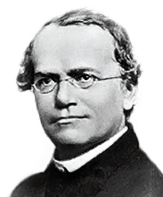
Today in How It Works, we are going to take a step away from the molecular areas of genetics, and are going to instead talk about evolution!  More specifically, we are going to talk about this dude:

Look at those glasses.  Has to be a scientist.

This man, who lived back in the 19th century (1822-1884, to anyone who’s interested), is named Gregor Mendel.  Growing up in Austria, he worked on a farm as a child, and chose to join the Augustinian monks to help afford his studies, as the monks would pay for his education.

At the university where he studied, Mendel chose to focus on heredity – a hot topic at the time!  He started off breeding mice together to track their traits, but the monks weren’t comfortable with him observing animal sex (squeamish lot, those monks), so he switched over to plants.

What Mendel observed, as he bred together pea plants while looking at certain traits, is that it was possible to create what were known as inbred lines – that is, lines that always showed a certain trait!  Back then, there wasn’t a clear understanding of the existence of genes, so scientists could only observe the phenotype – that is, the physical appearance of the organism in respect to a specific trait.

Mendel, in true scientific fashion, tried to only focus on a single trait, figuring that the fewer variables he had to track, the better.  For this example, let’s take pea pod color (which comes in two flavors: green and yellow).  If Mendel bred some wild-type plants together, he would get a mix of greens and yellows.  But if he kept on breeding only green or yellow plants together, he eventually found that all the offspring would be 100% green or yellow, matching the color of the parent.

Now, that’s not too interesting.  If you keep on selecting for a trait, eventually you only see that trait.  Awesome.  But when things got really interesting was when Mendel decided that, after creating an inbred line of green peas and an inbred line of yellow peas, he was going to breed the two different inbred lines together.

The first generation of offspring from this cross (usually referred to as F1) was all green peas.  Pretty dull, although it’s interesting that green seemed to dominate over yellow.  But not yet willing to give up, Mendel decided to go ahead and cross this F1 generation to itself.  The results from this cross were surprising.

Mendel saw that in this next generation (the F2 generation), he would see three green pea pods for every yellow one.  And no matter how many times he tried this F2 cross, he still saw this remarkably stable ratio of three to one.

From this, Mendel deduced that there were two alleles that represented these two colors.  The green allele made pea pods green, while the yellow allele made them yellow.  Whenever a plant had one of each allele, it would show green; the green allele is dominant to the yellow allele!

The big conclusion that Mendel drew, along with the existence of these alleles, is that these alleles were given to offspring independently.  This is known as the Law of Independent Assortment.  Here’s a handy chart to show how it works:

In this case, the big G corresponds to the allele that makes the pea pods green, while the small g corresponds to the allele that makes them yellow.  As you can see, the F1 individuals each have one big G allele and one little g allele; because the big G is dominant, they are green.  When they are bred together, 3/4 of the resulting offspring will inherit at least one G allele, and will thus be green.  But the last 1/4 will inherit a little g from both parents, and thus will be yellow!

One way to think about Mendelian inheritance as a set of rules:

  1. All genes have two forms: a dominant form, usually represented by a capital letter, and a recessive form, usually represented by a lower case letter.
  2. If a dominant allele for a gene is present, that is the phenotype that will be shown by the organism.
  3. The only time a recessive allele will create the phenotype is if there are no dominant alleles present for that trait!
  4. There is an equal chance for a parent to pass on any allele that it has.  In the above example, each parent in the F2 cross has a 50% chance of passing on a big G allele and a 50% chance of passing on a little g allele.
Makes sense so far?
Now, there are a ton of other factors that can influence inheritance, things like co-dominance, suppression, partial penetration, and haploinsufficiency.  But these will come into play later.  Mendel’s discoveries, although lost for many years, created a stir in the scientific community when they were rediscovered and shown to be correct.  

How to Talk to Professors

Now that I’ve started graduate school, I’ve had to go and talk with lots of professors.  Discussing class topics, planning presentations, setting up rotations, asking for letters of recommendation, getting advice on projects, etc., I decided that it’s time to share my thoughts on how to go about it, and what mistakes many people make.  So, without any further ado, let me present: How to Talk to Professors!

Before the meeting:

Get a notebook.  Even if you have an amazing memory, get a notebook.  And a pencil or pen.  Bring it with you.  Take notes in it.  It will keep you on track, help you remember anything interesting the professor mentions that you may want to look at later – and to the professor, it makes you look as though you really care about what they say.  Win/win.

Figure out what you’re after.  Why are you even bothering to talk to this professor?  This should be pretty obvious, but make sure that you’re aware of what you’re after.  If you want a letter of recommendation, this should be your primary goal.  Want a rotation slot?  That’s your goal.  Write this at the top of your notebook so you won’t forget, should you be distracted or the topic veer off topic.

Read up on the professor.  This depends a bit on the professor, but the best way to seem smart and knowledgeable is to be prepared.  (Also, the best way to seem undesirable is to go in with no background, should your goal be to bomb the meeting.)  And I mean more than knowing the professor’s name!

  • Website bio.  Everyone has a website with a bio on it these days.  Find it by Googling your professor’s name and give it a quick read.  Chances are good that it hasn’t been updated since 2010, but check it out nonetheless.
  • Their last 3-5 significant works.  Most professors write research papers, which are then published.  If they’re in biological sciences, put their name into NCBI’s database and see what comes up.  If they’re in a different discipline, you may need to find a different database.
    • Note: do not read the entire paper!  Do it if you’ve got time, but usually you don’t need to bother.  Read the abstract, introduction, and conclusions/discussion.  That usually gives you enough to follow along in their talking without having to memorize too much.
  • The syllabus.  Meeting with the professor for a class?  First, make sure your answer isn’t in the syllabus.  If you show up and ask about something clearly stated in the syllabus, the professor will irrationally hate you for the rest of the class. 
Location, location, location.  Do you know where your professor’s office is?  Are you sure?  Better double-check (good thing you found their website already!).  Figure out how to get there, and plan an extra 5-10 minutes to account for getting lost in the labyrinthine halls of these massive buildings.  Who decided that a Space Invader was the best floor plan layout anyway??
Was that a left or right at the antenna?

At the meeting:

Check yourself before you wreck yourself.  In terms of fashion, I mean.  Take a quick look down at what you’re wearing.  Does your shirt have a beer logo on it?  Is that clever saying on your hat offensive to women, minorities, gerbils, and anyone who knows the difference between ‘your’ and ‘you’re’?  If so, take it off or cover it up.  You don’t need to be wearing a suit and tie, but make sure you look presentable.  Button-up or polo shirt, no food stains, and comb your hair.
Don’t talk, listen.  I’ve found that, at most of my meetings with professors, I tend to do between 25-40% of the talking.  That’s right: I’m never talking even half the time.  People in general like to talk about things they know about, and the professor knows more about his topic than you.  Shut up and let him talk.  He feels good that you’re listening to what he has to say, and you’ll get to not have to worry about saying something really stupid.
Body language.  We’ve all seen that quote that says that 90% of communication is nonverbal.  Well, show it, you slacker.  Sit up, keep your eyes on the professor, write down little bits of what he says so that you can go back to it later, and give him/her an encouraging nod whenever he or she pauses.  Keep a smile on your face.
  • Don’t fidget.  I’m making a separate note here: if you’re nervous, lace your fingers together and twiddle your thumbs inside this little finger-igloo.  Even better, do it under the table.  This way, the professor can’t see that you’re nervous.  
Don’t fall asleep at the meeting.  Drink caffeine if necessary.

Rephrase.  Is the professor staring at you, waiting for you to say something?  Do you have no idea what answer he or she wants?  Instead of fumbling with lots of pauses and ums, simply say something like:
“Let me just make sure that this is clear: you’re saying that if a pig has a wingspan greater than three times its body length, it should be able to generate sufficient upward thrust to at least leave the ground?”
Obviously, don’t say that.  But take the last point the professor was stating, rephrase it slightly, and pose it as a question.  If you’re wrong, the professor will assume that he or she didn’t make the point clear enough and will repeat it.  If you’re right, the professor will usually leap off of where you ended with that upward lilt, continuing on towards the point he or she was trying to get you to guess previously.  
The professor runs the conversation; you steer.  This is a lesson I had to learn through experience.  If you’re sitting there doing the listening, the professor will be talking, and will be running the conversation.  But don’t forget, you’re there for a reason!  That reason should be written at the top of your notebook.  Glance down if you’ve forgotten it.  So just add a comment here or there, but keep on steering the conversation back towards your goal.  
  • Want a rotation slot?  Mention your current rotation and how it’s going, or ask about current lab research the professor is doing.
  • Want a letter of recommendation?  Mention the scholarship/job opportunity/fellowship and comment on how you’ve been working really hard on the application and/or essays.
  • Want a grade changed?  Well, good luck with that, but mention how you’ve been doing a lot of studying for their class, or how you felt that the recent test was very specific.
DO NOT disagree with the professor.  Or if you do, be extremely wary.  No one likes being told that they’re wrong.  And if you say that they are, they will almost always dig in their heels against you.  Research on cognitive dissonance say that, even if the professor is in the wrong, they won’t want to change their mind – they certainly don’t want to be corrected!  If the professor is really, obviously, definitely wrong, pose your correction as a suggestion or question to give them a better avenue to correct themselves and save face.
At the end of the conversation, if you don’t have your answer, ASK.  It is incredibly frustrating to walk away from a meeting with a professor without an answer.  If you go in to get a letter of recommendation, don’t leave until you’ve asked for one!  Better for them to say no so that you can move on, than for them to not answer and leave you stuck in the lurch.  If they’re wrapping up and you don’t have an answer, say something like:
“Professor Boltzmann, thank you for taking the time to talk to me.  I really liked hearing about your work, and I would greatly enjoy the opportunity to help contribute by rotating through your laboratory this fall.  Would there be an available spot for me?”
Easy as that.  You’ve got your answer.
After the meeting:

Follow up.  Promptly.  Did the professor request anything from you, such as a CV, resume, essays to read, test to review, etc.?  If so, send it to him as soon as you get to your computer.  Don’t delay.  If there are any materials they need, such as a link to click for submitting a letter of recommendation, make sure to send that to them as well.  Even if they don’t need any other materials…
Thank them.  Even if they said no.  All it takes is a quick one-line email that says, “Dear Professor Boltzmann, thank you for taking the time to meet with me today – I enjoyed hearing about your research.  Sincerely, me.”  Little details like thank-you emails can be the difference between a professor tackling your request right away, or tossing it on the bottom of their to-do pile.  It can also serve as a reminder about what you asked for, should it have slipped their mind already (which does happen).
Don’t write a thank you in crayon though.  Even if your handwriting’s this good.
Send reminders/thank you messages before the deadline.  Not after.  If there are five days until the letter of recommendation is due and the professor still hasn’t uploaded it, send them a quick email thanking them for agreeing to write their letter.  This will both remind them of the upcoming deadline, and make them feel guilty for not doing it yet.  
Reward yourself, and then jump back in.  Congratulations, you talked to another human being without hyperventilating too badly, passing out, or throwing up on them!  Give yourself a brownie as a reward.  Now, eat that brownie quickly, because now you need to move on to the next professor.  Start prepping for your next meeting!
Disclaimer: if any of these tips backfires on you, well, you probably did it wrong.  I take no responsibility.

A Word of Advice

Psst!  Hey you!  Yes, you, right there, looking at the screen.  Come in close, would ya?  I’ve got something to tell you.

Look, I know you.  No, don’t try and shake your head at me.  I know you.  You seem pretty well put together at first glance, make a pretty decent first impression.  Or at least a second impression.  You’re not a bad person, you’ve got some natural talents, some gifts, you’re not the dullest tool in the shed.  And hey, you know this.  So then, why are you so… what’s the word…

Ordinary?

Yeah, that’s it.  And I know that, deep down inside, you don’t want to be ordinary.  You want to excel, be unique, stand out from the crowd, have something about you that no one else has.  Because hey, don’t we all.  Look around.  Everyone wanted to be normal as a kid, and now they want to be unique as an adult.  Paradoxical, ain’t it?

But no, you want to excel.  At something.  And hey, don’t we all.  But we’ve tried, and I can certainly attest to it, it’s damn hard.  Trying to be good at something takes work.  And to be great?  Good luck, there’s always someone out there who’s further ahead, further down the line.  And at some point, you stop and say to yourself, might as well give up now, huh?  Call it, not waste any more effort?

So here, I’ll help you out.  Lay a little truth on you.  You see everyone else around you, all those people who are better than you, who can somehow always have the right thing to say, to do, for whom everything always seems so damn easy?  See them?  The people who somehow seem to have it all figured out?  See them?  Know them?

It’s a lie.

Everyone, every single person around you, is scared, paralyzed, in mortal fear that you can see through the chinks in their armor.  They’re all projecting out shells of knowledge, of confidence, trying to seem impenetrable, while inside they cry and mewl in helpless despair.

That speaker, confidently giving his presentation?  He’s spent months slaving over this topic, and is scared to death that someone will ask him a question he doesn’t know, or he’ll blank on the answer and be booed off stage.  That guy effortlessly chatting up the babes at the bar?  He’s been rejected so many times, and he remembers every one of them, each with its own unique, exquisite sting of failure.  That girl strutting down the street, dressed in high fashion and making every man’s head twist to follow her figure?  Just this morning, she stood in the mirror, observing every minuscule flaw and hating herself for them.  They all seem so sure of themselves, but inside, they’re just as fragile as you or me.

So, what’s the difference?  If we’re all the same inside, why are they able to pull it off?  How can they step forward when everyone else hesitates or steps back?  What do they have, that you and I lack?

Really, it’s rather a chilling answer.  They know that they will fail.  They have failed before, have taken those wounds, sustained those scars.  And they kept on going.  It’s not natural talent, or trained skill, or confidence, or poise, or ability, luck, happenstance, or fortune.

No, it’s raw, bloody, dogged determination.  They refuse to hide away, to stay safe from rejection, failure, disappointment and sadness.

It’s the reductionist approach to life: if you keep it small, you’ll keep it under control. If you don’t make any noise, the bogeyman won’t find you. But it’s all an illusion, because they die too, those people who roll up their spirits into tiny little balls so as to be safe. 
Safe?! From what? Life is always on the edge of death; narrow streets lead to the same place as wide avenues, and a little candle burns itself out just like a flaming torch does. I choose my own way to burn.

-Sophie Scholl

How it works: SDM!

Welcome to How it works, a new and (hopefully) illuminating series on many of the techniques that I, as a biologist, am familiar/somewhat familiar/not at all familiar with!  Read on, but be prepared to learn!

So, in the last How it works, I talked about PCR.  PCR, as you may recall, stands for Polymerase Chain Reaction, and is a way of making a lot of copies of DNA, very fast!  Seriously, once you know your sequence and have a couple strands of the DNA, you can go from 2 strands all the way up to 20,000 strands, all identical, in an hour or less.

But wait!  What about if you want to make a couple small changes to your DNA?  In order to explain this, I’ll lay out a nice, hypothetical example:

You’re a researcher, working on, for example, fingers!  You go out and take a bunch of DNA samples from six-fingered people (this condition is actually called polydactyly), and compare the DNA sequence to that of normal, five-fingered people.  You compare the DNA using sequencing, which will be explained in another episode.

Now, you find that the DNA is almost identical – except in one spot, instead of there being an A in the DNA, you find a T instead!  (Remember, DNA is made up of only 4 bases, A, T, G, and C, combined in long strings, a bit like computer code.)

So, you hypothesize, if a person has a T in this spot on their DNA, instead of an A, they grow six fingers instead of five!  But you can’t just call it quits now – you don’t have any experimental proof, nothing to show that this isn’t just coincidence.  So you decide to do an experiment!

Now, first off, you can’t go around giving people extra fingers (unless you’re a mad scientist or something, in which case feel free).  So instead, you look at mice, and notice that they have this exact same gene.  Great – there’s no problem with giving mice extra toes!

So, you now have 2 different directions your research could take.  You could:

  1. Search through millions of mice until you find some that have extra toes, and extract their DNA and see if it shows that same mutation A -> T.
  2. Take normal mice, use a technique called Site-Directed Mutagenesis, or SDM, to change DNA from them to have the T instead of the A, and see what happens when you put it back into new mice.
Do you know which path is best?  Here’s a hint: we want the method that doesn’t involve searching through millions and millions of mice, counting toes.  We’re taking door number 2!
As you recall, PCR works by separating the two DNA strands, attaching primers to each strand as starting spots, and then synthesizing the rest of the DNA in the complementary strand, building off the primer.  SDM works almost exactly the same way – but with one difference.  Another primer is included!
This third primer is made to cover the spot where the mutation should occur.  Remember, primers are usually 7-10 bases long, so even with one base in the middle altered (to create the mutation), it will still bind very strongly to the DNA.  It might look something like this: 

On this picture, ignore the red circles, but look at the two strands of DNA (black lines) with the SDM primers (blue lines) attached.  See how the blue lines have one base that is incorrect, making them kink away from the DNA?  That’s intentional!  
Now, after the first round of DNA synthesis, the new strands, made from these primers, will have that mutation, that single changed base, as a part of them!  And because every DNA strand will be made with these altered primers, 99.9% of the DNA from the reaction will be mutated, just as you wanted, instead of containing that original A instead of T.
(Can you see why this process isn’t 100% effective?  If you guessed that it’s because of the original strand of DNA, you’d be right!  That strand is unchanged, and so it will still have the A instead of the T.  Since we’ve made thousands of copies, though, the chances of that original strand being the one used is very low, however, so we don’t worry about it much.)
So after reading this, hopefully you’re starting to see a bit of the power of PCR – not only can it make thousands of copies of a single piece of DNA, but it can also be used to introduce very specific changes at exact locations!  And all of this can happen while you take your lunch break, you productive researcher, you.

How it works: PCR!

Author’s note: This is part of an installment on how many methods and techniques in biological sciences work, written for educational purposes!  Hopefully, this blog will rise to be something more than silly short stories.

If you’ve ever worked in a biology lab, you’ve probably heard professors, researchers, or even other students talking about PCR.  But what in the world is this strange acronym?
PCR stands for Polymerase Chain Reaction, and is a method for amplifying DNA!  This process can take a few strands of DNA, or even a single strand, and turn it into thousands of (nearly) identical copies! Although it has a few limitations, it is a very rapid, powerful tool, and has many different uses.
So, you may be wondering, how does PCR work?  It’s simple, and all depends on temperature.  But first, a little refresher on DNA.
DNA is made up of two strands, each of which is complementary to the other.  Because they are perfectly complementary, they fit together, bonding perfectly.  Think of it like ripping a piece of paper in half – the two pieces of paper will perfectly match up together, unlike any other ripped piece of paper!  Same thing with DNA.  Once enough complementary bases are in a strand of DNA, it will only fit perfectly with its exact match.
Even though DNA normally sticks together, it does separate – when heated up!  In order to separate the DNA, the solution containing the DNA is heated up to between 95 to 98 degrees Celsius, near-boiling.  At this point, the DNA peels apart into the two different strands, but doesn’t fall apart quite yet.
Now, the enzyme that copies DNA is known as polymerase, and it’s a big, complex protein.  Polymerase attaches on to an exposed single DNA strand, and builds the complementary strand of the DNA.  Bam, DNA copied!  Unfortunately, it’s not quite that easy – there are a couple requirements of polymerase, however, that make it a little tricky to work with.  
The first issue, which made PCR impossible for a long time, is the fact that polymerase is heat-sensitive.  If you heat the protein up too much, it acts a bit like a spaghetti noodle – it falls apart, and no longer performs its DNA-copying function.  Even if you cool it back down, it is still broken.  Now, when you have to heat up the DNA to separate the strands, this becomes an issue.  
The way to solve this problem is actually rather ingenious, in terms of biology.  In some hot vents, such as those found in hot springs in Iceland or at the bottom of the ocean, certain bacteria (known as thermophilic bacteria) are able to thrive.  In order to survive in the boiling-hot water, they have evolved special forms of enzymes that remain stable at very high temperatures.  The polymerase used in PCR comes from one of these bacteria, T. aquaticus, and is thus known as Taq polymerase.  It doesn’t break down in hot water!
The other issue with polymerase, however, is that it can’t start on just a single strand – it needs to start on a double strand.  This means that if you chop a bit out of a double-stranded piece of DNA, the polymerase can copy that area missing its complementary strand.  If you have a single strand by itself, however, there’s no place for the polymerase to attach.
Now, in order to get around this problem, two different short pieces of DNA, known as primers, are added to the mix for PCR.  These primers are usually 8-10 bases each in length, and are specially selected to perfectly fit the DNA strands at either end.  This means that the primer forms a very short section of double-stranded DNA, allowing the polymerase to attach!
The last thing needed for a PCR to work successfully is the raw ingredient – the bases that DNA is built from!  These are easily synthesized, and are added to the mixture so that the polymerase has raw materials to use to build its strands.
So, PCR goes through three steps – denaturing (where the DNA separates into single strands), annealing (where the DNA is cooled off enough for the primers to bond to either end of the single DNA strands), and elongation (where the polymerase attaches to the DNA at the double-stranded primer, and then builds the second strand down the rest of the length of the strand).  Each of these steps is performed at a different temperature, so a PCR machine, also called a thermocycler, rotates a sample between the three temperatures.  Although temperature can vary, denaturing is usually around 96 degrees, annealing happens around 58 degrees, and elongation is generally at 72 degrees.  The thermocycler simply keeps on cycling the temperature of the sample between the three programmed temperatures.
Because the primers/Taq polymerase combination makes a copy of every single-stranded DNA molecule, each cycle should, in theory, double the amount of copied DNA!  Here’s a quick example:
Start with 1 strand.
After 1 cycle, you have 2 strands.
After 2 cycles, you have 4 strands.
After 3 cycles, you have 8 strands.
After 4 cycles, you have 16 strands.
After 5 cycles, you have 32 strands.
As you can see, the amount of DNA grows very rapidly!  Of course, this growth stops if you run out of primer pieces of DNA or raw bases, but in general, this method allows for millions of copies of DNA to be synthesized in a half hour or less.
PCR has a couple other limitations.  Because polymerases don’t copy DNA instantly, there is a limit on how long the copied DNA strands can be.  The maximum length of DNA that can be copied by PCR is about 10,000 base pairs, although some methods can go up to 40,000 base pairs.  PCR also has occasional errors, as the Taq polymerase has an error rate of about 1 in 10,000 bases.  Sometimes, the copied DNA strands aren’t perfect – and that, of course, means that future strands copied from those are also flawed.  
Despite this, however, PCR is a very powerful tool, and is used all the time in biology labs!  And now, you know how it works!