The Art of Insults, Part II

Continued from Part I.

“Listen,” Gerry began, “there are two ways to insult someone.  Intentionally, and unintentionally.  Here, I’ll show you.  Insult me.”

I raised my eyebrows at the bald fellow, but he seemed serious enough.  “Uh… you’re old and bald,” I offered.  I wasn’t sure exactly how harsh I should go.

Gerry didn’t seem phased by this terrible, incredibly offensive attack, however; he merely nodded, as if accepting that I was right.  “Yep, sure am,” he confirmed, still nodding.  “Now, if you had said something that was actually hurtful, like telling me that I had a tiny dick and I deserved to go die in a fire, well, I would have been a bit hot and bothered.  But insults like that?  Easily shrugged off, and most of the time they really don’t stick with a fellow.  They’re temporary.”

I’m confused.  I took another swig of my drink to cover up the blank look on my face, but Gerry still spotted it.  “Those, you see, are just intentional insults,” he went on.  “And although they make us feel better when we yell them at someone else, they don’t mesh with what we believe about ourselves.”

My face must still have showed my confusion.  “Like this,” Gerry continued.  “You’re an imbecile.  You are.  Now, how’s that make you feel?”

I shrugged.  “Honestly, it doesn’t really bother me,” I said.

“Exactly!” he replied.  “Because in your head, you know that you aren’t an imbecile.  Your internal image of yourself is that you’re a pretty smart guy.  So when I call you something that doesn’t match your internal view, your brain rejects it, brushes it off.”

This actually made some sense.  “Isn’t there some psychological theory about that?” I asked.  I could vaguely remember reading about something like this, what seemed to be a million years ago in college.

Gerry shrugged.  “Probably.  But this means that, if you really want to hurt someone with an insult, you have to take an entirely different approach.”

“Do you have to get something that they actually believe, inside their heads?” I guessed.  “Strike at their inner weakness?”

“If you do, sure, that’ll land a knockout punch,” Gerry acceded.  He paused to raise a finger to our bartender, who nodded and busied himself pouring a beer from one of the taps.  “But good luck spotting someone’s weakness like that – especially on a stranger, like Ned over there.”  He nodded across the bar at the gray-haired man, who cackled as he lifted his glass in a mock toast.  “No, there’a much easier method, one that won’t rely on guesswork.”

I was leaning forward a bit in my seat, and I had finished the rest of my drink without noticing – Gerry could tell that I was interested, hanging on his words.  He grinned, obviously enjoying being the center of attention.  “You gotta insult them unintentionally,” he imparted, as if sharing a great secret.

I sat back a little.  “You’ve got me confused again,” I confessed.

Gerry waved one hand in the air in a vague and meaningless gesture.  “Let’s go back to that internal picture of yourself,” he said.  “Now, you don’t believe that you’re an idiot, but nobody, on the inside, is really, truly, confident in themselves.  Like you.  What’s something that you’re good at?”

At first, I thought of mentioning my job, but that idea was quickly squashed – if I was truly good at it, I wouldn’t have been kicked to the curb.  “I can play a pretty decent bass guitar,” I offered, my head filled briefly with visions of my garage band from college.

“Sure, that works.  Now, imagine that you were at a party, you picked up a bass guitar, you played a couple songs.  You’re enjoying yourself, and then one of the other party guests walks up and comments that your playing sounds great!  Before you can thank him, however, he guesses that you must have been playing for three or four months.  Now, how are you feeling?”

I closed my eyes for a minute as I envisioned this scenario.  A clink next to me signaled the arrival of Gerry’s beer.  “And one for this gentleman, too,” he commented.

To be continued…

The (Lack of) Glamour of Air Travel

Similar to riding horses, shopping in Abercrombie and Fitch, and playing craps at a casino, traveling by air is one of those activities that always seems glamorous and fancy up until you actually do it.  Hold on a minute, scratch that.  I’ve played craps before and it’s quite enjoyable.  Replace that with taking a taxi.

I have performed all of these activities, and one of their most striking qualities is how much less fun they were to do than they seemed from afar.  As a graduate student living halfway across the country from the rest of my family, I find myself at the unfortunate intersection of “needing to fly regularly” and “I’m poor and need to take three flights at 1:30 AM”.  And this is not a fun intersection to be stranded at.

But traveling via airplane is an interesting combination of wonder and utter frustration.  The indignity and bother of removing every single object from my person at security screenings?  The incredibly overpriced and meager selection of food for sale in airports?  The disturbingly squishy chairs that somehow can never be comfortable for more than five minutes?  The stale, dry, dirty air on the planes themselves?  All of these little frustrations come together to make traveling by air a rather unpleasant experience.

On the other hand, I can never quite shake that sense of wonder I feel as the plane finally lifts off from the runway.  Wilbur and Orville Wright flew for the very first time in 1906 (I know that off the top of my head – be impressed), and now, barely over a hundred years later, we clamber fearlessly into metal tubes that streak across the sky, higher than we can breathe, propelled by the constant combustion of incredibly flammable liquids.

Flight is a marvel, something that humanity has strived to attain for thousands of years.  And yet, today we treat it as an inconvenience!  What plasticity the human mind possesses, to shift its mindset so radically in just a few generations.

But I’m a scientist, not a philosopher, so I’m going to brainstorm a few ways that we could shake off a few of the annoyances associated about airplanes:

1. Security checkpoints are long and annoying.  We may have switched over to millimeter wave detection, but why in the world do we still need to take off our shoes and empty our pockets?  Let’s get some automated smart scanners that generate a three-dimensional scan and identify weapons, combined with chemical sniffers that can detect single molecules of explosive.  And to be honest, I don’t really care if some balding TSA agent happens to see my outline beneath my clothes – more incentive for me to stay in shape!

2. The single most infuriating thing about air travel, in my opinion, is the waiting.  Oh god, so much waiting.  I’m sure that most airlines have very complicated computer algorithms to determine when and where flights take off from and are destined to land, but let’s take it a step further.  When I check in, I want to be sent an electronic boarding pass with a QR code and a date and time.  I want to know that, at that specific time, I can walk straight onto the airplane.  We’re already getting close with zone boarding, just put everything on a timetable!  You’ll know exactly when you need to be at the airport, and with security automated, you simply walk in, spend 30 seconds being scanned by computer, and then proceed directly to your gate and onto the plane.  And if you miss your flight and rant to the gate agent, let them kick you out – there’s a giant time stamp that told you exactly when you had to be there.  So sorry you failed to comply with the clearly presented information; better luck next time.

3.  A simple request: give us some damn couches in the waiting areas!  When my connecting flight lands at 2 AM and I have three hours to kill until my next connection boards, I want someplace where I can actually stretch out without having several metal armrests enthusiastically attempt to mate with my spine.

4. Solving the food issue seems pretty simple if security can be resolved; with rapid, automated security checkpoints, it shouldn’t be hard to walk out, grab a cheap and delicious burrito from someplace like Chipotle, return in through security again, proceed directly to your flight, and then sit there regretting your choice in meal.  No more taking advantage of the trapped herd of fliers inside security, tiny and unappealing food kiosks!

5. Comfort on the plane itself is a bit trickier.  Sure, we could rip out half the seats on the plane so that we can all enjoy a bit more leg room, but the airlines are already running on pretty razor thin margins, and the more people they can corral onto a plane, the better.  So let’s go the other way; instead of removing seats, let’s improve them!  I’m thinking that we go the modern route, get Aeron in here to make us something beautiful out of nano-engineered mesh, and then make some cheap ripoffs.  These seats are three inches thick and still uncomfortable – shaving off a couple inches would make the seats a bit larger (for the, how shall I say, heftier fliers), add more leg room, and probably also reduce weight, which provides greater savings to the airline!

6. Free wifi on planes.  Seriously, why are we still charging for wifi on an airplane?  Motel 6 and most strip clubs have free wifi, for god’s sake!  (I am strangely proud of getting both god and strip clubs into that last sentence, by the way.)  I’m writing this post on an airplane right now, but I won’t be able to post it until we land, as my pride prevents me from spending six whole dollars for internet access.  I mean, that six dollars could nearly get me a tiny side salad in the airport.

The Art of Insults, Part I

Rubbing my forehead with the back of one hand, I hauled open the heavy wooden door and stepped into the bar.  I had always enjoyed the throwback atmosphere of the bar, just down the street from where I worked.  Had used to work, I mentally reminded myself.  Had to get used to using the right script.

After my eyes had adjusted to the internal gloom of the bar, I sidled up to the counter, finding a spot equally between the few grizzled old men that seemed to be permanent fixtures around the counter.  I didn’t make eye contact with any of them, but a gray-haired fellow on my left still began grunting as he slid closer to me.  “Bit early for yeh to be drinking, doncha think?” he wheezed out through the bent bars of his remaining teeth.

The old-timer was right; I usually didn’t show my face in the bar for another few hours, when work let out and happy hour began.  Today, of course, I didn’t have to wait that long.  Another advantage of being unemployed, I suppose.

I ignored the man, instead raising a finger to catch the bartender’s attention.  “Whiskey, double,” I requested, when the man sauntered over.  He nodded without speaking a word, turning and ambling off, taking his sweet time to prepare my beverage.

Fortunately, as there were no other placed orders to compete with mine, my drink arrived in front of me in short order.  I traded the bartender my credit card for the drink and took a long pull.  I was still on edge, however, overwhelmed by the stress of the day, and some of the fiery liquid went down the wrong tube.  I choked, coughing as I slammed the glass back down on the bar.

The gray-haired man, now sitting next to me, let out another wheezing bray.  “Di’nt your dad ever teach yeh houw to drink?” he got out between laughs.  “First rule is that you’re sposed to swallow!”

I glared at this annoying boil of a man.  “Screw you,” I told him, taking another pull of my drink.  This time, it went down properly.

Out of the corner of my eye, I caught the man on my other side, this fellow nearly completely bald, also scooting closer to me across the bolted-down bar stools.  “What?” I snapped, turning to him.  My anger was fully raging by this point, helped along by the heat rising from my belly.  “You got something to say as well?”

Instead of sneering at me, however, this fellow merely put on a slightly self-satisfied looking grin.  “Actually, I was going to correct you,” he said, and I was forced to slightly alter my opinion of him.  Despite his wrinkles, this man still had all of his teeth, and was currently giving me a million-watt smile.  His voice was also slightly clipped, giving him a barely perceptible cultured accent.  “You’re doing it wrong.”

“Doing what wrong?”

“Insulting,” the bald man replied.  He had by now reached the stool next to mine, and he offered his hand to me.  “Gerry,” he said.

“Arthur,” I replied, taking the proffered hand.  Gerry gave it a single brisk pump, and then released – the kind of handshake I had grown accustomed to at my old job in finance.  “You’re saying that I’m insulting him wrong?  Is there a right way?”

Gerry kept up his smile.  “Perhaps not a right way or a wrong way,” he said, “but there is definitely a better way and a worse way.  And you, my new friend, are using the worse way, I’m afraid.”

On my other side, I saw the gray-haired man roll his eyes and begin shuffling back to his original spot, where he had abandoned his drink, but I was interested.  Gerry sounded as though he was slipping into a lecture, as if speaking in front of a class.  I might be a class of one, but I gave him my full attention.

To be continued!

Missing Brains Will Return!

Hello, dusty and abandoned wilderness of the internet!

Now, I know that Missing Brains, this blog that you have come to know, love, and depend on for guidance in your life, has not been updating for nearly two months now.  And I won’t apologize for that.  Not only have I passed my first quarter of graduate school, but I’ve also found the time in the last couple of months to write an entire novel – in a month!

So, that’s pretty awesome.

Unfortunately, the novel is nowhere near reading-quality yet – I have side characters wandering off and disappearing, and others somehow managing to completely shift and mutate their personalities as the book goes on.  I’m going to have to hew at this with an axe for a while before it’s ready to see the light of day.

Also, when I do release it, it will probably cost money.  Gotta pay for my cardboard box and lentils somehow!

But what about our free content? I can hear you asking.  Missing Brains used to give me the occasional chuckle or groan for free, and I want that back!  Well, never fear!  Regular updates to Missing Brains will return in January.  One of my New Year’s resolutions is invariably to write more – maybe one of your resolutions should be to read more!

Or even, if you’re feeling like an especially awesome person, to donate to that favorite blog of yours and help out the author!  I’m sure he or she would totally appreciate it, and not just put the money towards booze.

So don’t despair, and keep on checking back!  Like that burrito that you thought would be a good choice instead of a real lunch, Missing Brains will return!

Update and musings!

Hello, random spam and Google indexing bots that are still remaining loyal to my site!

First off, despite what the major media outlets are claiming, I’m not dead.  I am alive and well, kept busy by both work, working on my NaNoWriMo novel, and by the fact that Netflix has just released all five seasons of Chuck for online streaming.  Damn you, Chuck, and your silly everyman approach to being a super-spy.

If you’re wondering about progress on my novel, as I am sure that you all are (thoughts of a search bot: “Yay, he’s writing more stuff for me to index in hopes of coming across a tasty nugget of advertising!”), rest assured that I am meeting and exceeding my word targets.  It is currently day 8, which means that my novel is supposed to be at 13,333 words by the end of the day.

My novel is 20,000 words.  And I’ll work on it more this evening.

Thank you, search bots.  Please, you can stop your electronic beeping.  Is that supposed to be applause?  You should work on that.

However, I don’t just want to talk about all the congratulations that I’m receiving – no, I currently have a different train of thought passing through my mind-station.  And that train is named “The concept of intelligence.”  Weird name for a train, I know.

If people were given the choice of any three qualities or characteristics for them to wish to possess, their choices would likely be something like “Rich, Popular, and Smart.”  Actually, for some people they may replace “Smart” with “Beautiful/Handsome”.  Fine, Smart is in the top four choices.

But saying whether someone is smart or not is quite difficult.  And, surprisingly, I feel that, just like wealth, intelligence is a trait that can be changed – unlike looks, you can work on being smart!

In talking to many people, and reading many accounts on the internet (“See, I’m not just on Reddit to goof off – I’m conducting important sociological studies!”), I’ve seen a tendency for people to consider themselves either “smart” or “dumb”, and usually in a pretty static range.  They point at things like IQ tests, Mensa memberships, grade point averages, or college/job history to prove their intelligence.

I don’t feel that this is a good measure, however, as plenty of Mensa members tend to be arrogant blowhards that could use a couple months with their jaws wired shut.  And at the same time, I’ve heard people who would consider themselves to be “stupid” make surprising flashes of brilliance.  Instead, I feel that intelligence should be defined in a couple of different ways:

1. Intelligence should be segregated by area.  Knowing about biology, genetics, and biochemistry, while admirable, does not mean that I should let you fix my car.

2. For each and any area, intelligence should be defined as such:
“the amount of factual information known”
multiplied by
“the ability to draw inferences, make connections, and bridge gaps in this knowledge”
multiplied by
“the ability to express ideas clearly, as a percentage”

This formula is simple: there are three ways to increase your intelligence in any area!

Approach 1: learn more.  Read books, practice a skill, watch others, ask questions, add to your mental library.
Approach 2: practice making connections.  This is probably the toughest to train (and thus, comes the closest to being intelligence that you are born with).  But the more knowledge is truly understood, including the reasoning behind it, the more connections can be made.
Approach 3: talk, talk, write, and talk again!  I know so many intelligent people that are mind-numbing bores when they speak.  If you can’t communicate an idea clearly, you may as well not know it at all.  It is trapped in your head, unable to get out!

“But, Samwise, why do we even need to redefine intelligence at all?” you ask me.

“Spambots, it is very clear why this is necessary,” I reply.  “And I shall provide a personal example.  I know a person who knows nothing about science, my chosen field.  Biology is a mystery to her.  I possess years of experience and factual information about things like DNA, RNA, recombination, and genetic analysis that she does not.

“However, when I explain concepts to her, as soon as she has the background, she is able to quickly and intuitively follow my leaps of progression!  In her formula, the first value may be low, but the second value is high.

“Does this mean that, even focusing on biology as an area of intelligence, that she is dumber than I am?  Well, yes, as a total value at the end of the formula.  But that is due not to a lack of brainpower on her part – merely the fact that she doesn’t have as many facts as I do!  It’s easier to win a race in a Lamborghini than in a Volvo, even if the Volvo has a racecar driver behind the wheel.  Looking at potential intelligence, the second value, she’s just as smart as I am.”

Of course, by this point the robots have long since stopped indexing the page, so I’m talking to myself.  But my point stands.  Our measures of intelligence are shoddy, and they need to be improved.

Temporary Hiatus

Attention, my dear readers: Missing Brains, the nearly-award-winning blog, is going to be going on hiatus for the next month.  Fear not, we will return, but for the next month, this blog will lie still and (mostly) dormant.

“But why!?” you might ask.  “Why would you forsake us, and stop providing us with free and mildly entertaining stories?”

Well, it certainly isn’t because I’m going to stop writing!  On the contrary, in honor of NaNoWriMo, I’m going to be undertaking an entire novel.  In only thirty days!

I can just hear you all now.  “Nano-rhyme-o?  What the heck is that?”

Not quite, but good try on the pronunciation!  National Novel Writing Month, or NaNoWriMo, is every November, when thousands of budding novelists all around the world try to sit down and write a full-length novel in just November – in 30 days.

“That sounds next to impossible.  Writing a whole novel?  In just 30 days?  Isn’t that, like, 5,000 words a day?”

Actually, it’s just 1,667 words per day.  A novel can be as few as 30,000 words, or as many as 80,000.  Some novels are even longer, but those tend to drag on, and should either be pared down or should be split into two different stories.  50,000 words is usually a good standard to aim for.  And working with Times New Roman, 12 point font, double spaced, this works out to only about 4-5 pages per day.

Now that doesn’t seem too hard, does it?

Actually, as a former NaNoWriMo survivor veteran, I can attest to the fact that it is quite difficult.  Plotlines change and evolve, new characters appear, and sometimes edits are needed.  And edits don’t count towards length requirements.

Add in to this that I have plenty of other work that comes ahead of writing, and NaNoWriMo becomes quite the challenge.  But never let it be said that I will back away from a challenge, so I’m going to give it a shot.

Want to track my progress?  Check out my writer’s profile here.  And wish me luck!  If anything, maybe consider becoming a participant in NaNoWriMo yourself!

Talk to you all at the end of the November?

How it works: Mendelian Inheritance!

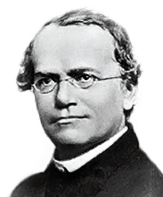
Today in How It Works, we are going to take a step away from the molecular areas of genetics, and are going to instead talk about evolution!  More specifically, we are going to talk about this dude:

Look at those glasses.  Has to be a scientist.

This man, who lived back in the 19th century (1822-1884, to anyone who’s interested), is named Gregor Mendel.  Growing up in Austria, he worked on a farm as a child, and chose to join the Augustinian monks to help afford his studies, as the monks would pay for his education.

At the university where he studied, Mendel chose to focus on heredity – a hot topic at the time!  He started off breeding mice together to track their traits, but the monks weren’t comfortable with him observing animal sex (squeamish lot, those monks), so he switched over to plants.

What Mendel observed, as he bred together pea plants while looking at certain traits, is that it was possible to create what were known as inbred lines – that is, lines that always showed a certain trait!  Back then, there wasn’t a clear understanding of the existence of genes, so scientists could only observe the phenotype – that is, the physical appearance of the organism in respect to a specific trait.

Mendel, in true scientific fashion, tried to only focus on a single trait, figuring that the fewer variables he had to track, the better.  For this example, let’s take pea pod color (which comes in two flavors: green and yellow).  If Mendel bred some wild-type plants together, he would get a mix of greens and yellows.  But if he kept on breeding only green or yellow plants together, he eventually found that all the offspring would be 100% green or yellow, matching the color of the parent.

Now, that’s not too interesting.  If you keep on selecting for a trait, eventually you only see that trait.  Awesome.  But when things got really interesting was when Mendel decided that, after creating an inbred line of green peas and an inbred line of yellow peas, he was going to breed the two different inbred lines together.

The first generation of offspring from this cross (usually referred to as F1) was all green peas.  Pretty dull, although it’s interesting that green seemed to dominate over yellow.  But not yet willing to give up, Mendel decided to go ahead and cross this F1 generation to itself.  The results from this cross were surprising.

Mendel saw that in this next generation (the F2 generation), he would see three green pea pods for every yellow one.  And no matter how many times he tried this F2 cross, he still saw this remarkably stable ratio of three to one.

From this, Mendel deduced that there were two alleles that represented these two colors.  The green allele made pea pods green, while the yellow allele made them yellow.  Whenever a plant had one of each allele, it would show green; the green allele is dominant to the yellow allele!

The big conclusion that Mendel drew, along with the existence of these alleles, is that these alleles were given to offspring independently.  This is known as the Law of Independent Assortment.  Here’s a handy chart to show how it works:

In this case, the big G corresponds to the allele that makes the pea pods green, while the small g corresponds to the allele that makes them yellow.  As you can see, the F1 individuals each have one big G allele and one little g allele; because the big G is dominant, they are green.  When they are bred together, 3/4 of the resulting offspring will inherit at least one G allele, and will thus be green.  But the last 1/4 will inherit a little g from both parents, and thus will be yellow!

One way to think about Mendelian inheritance as a set of rules:

  1. All genes have two forms: a dominant form, usually represented by a capital letter, and a recessive form, usually represented by a lower case letter.
  2. If a dominant allele for a gene is present, that is the phenotype that will be shown by the organism.
  3. The only time a recessive allele will create the phenotype is if there are no dominant alleles present for that trait!
  4. There is an equal chance for a parent to pass on any allele that it has.  In the above example, each parent in the F2 cross has a 50% chance of passing on a big G allele and a 50% chance of passing on a little g allele.
Makes sense so far?
Now, there are a ton of other factors that can influence inheritance, things like co-dominance, suppression, partial penetration, and haploinsufficiency.  But these will come into play later.  Mendel’s discoveries, although lost for many years, created a stir in the scientific community when they were rediscovered and shown to be correct.  

Ask Jackson Galaxy!

Do you recognize this man?  His name is Jackson Galaxy, and he is a part-time musician and full-time Cat Whisperer on the Animal Planet show, My Cat From Hell!  The editorial staff, here at Missing Brains, would love his input on several pressing topics of cat ownership that we have prepared here.

Yes, he IS the Cat Daddy.

  • Dear Cat Whisperer, my cat won’t eat his cheeseburger.  Are there certain toppings that he dislikes?
  • Dear Cat Whisperer, my cat insists on creeping into my room and whispering to me at night.  How do I make him stop?
  • Dear Cat Whisperer, I met an amazing guy on a date last night.  But when he came back to my house and saw my seven feline roommates, he turned tail and fled.  Should I call him right away or wait the customary day?

  • Cats.  Why?
  • Dear Cat Whisperer, my cat insists on bringing me dead animals – birds, mice, etc.  How do I get him to bring me my ex-wife?
  • For removing unwanted cat hair, should I use wax, Nair, or a razor?
  • Dear Cat Whisperer, my cat has the cutest little mask on his face like a bandit!  He also has lovely dark rings on his tail.  How do I discourage him from digging through my trash?
  • Dear Cat Whisperer, my boyfriend keeps texting me how he wants to “punish my kitty.”  Why does he want to hurt Snuggles?
  • Dear Cat Whisperer, I think I’m not going to wait to call him.  I’m sure he loves me!
  • Dear Cat Whisperer, I’ve heard stories of cats gnawing off people’s faces.  Is there a flavor they especially crave?  Can I get a new, better face afterward?
  • How do I improve my cat’s grammar?
On behalf of the editorial board here at Missing Brains, we look forward to Mr. Galaxy’s responses!

Out Beyond The Walls – writing short

No, this isn’t connected to any other story yet.  Just a bit of post-apocalyptic character building.

As I gazed around the interior of the ruined building, uneasily noticing how the other members of Terry’s crew seemed to occupy their spare time by using pointy objects to pick at their teeth or nails, or sharpen their blades, something nagged at the back of my mind.  Something about Terry’s description of his allies.

“Wait a minute,” I said, turning towards Terry.  He was still standing beside me, obviously enjoying my discomfort, thrust into this world with which I was totally unfamiliar.  “You said that you had four other people in your crew, right?”

“I did,” he agreed, grinning at me.  His hands hung free, but I knew that, if I made the slightest aggressive move, he would have the pistol at his waist free in a heartbeat.  Although I doubt he’d waste a bullet on me.  Not when a knife would work just as well, and be much cheaper.

I glanced around the dusty, shadowed interior.  “I only count three,” I said, my eyes roaming over each of them in turn.  Jhang was using a dagger to clean his nails, perched contentedly atop an overturned shelving unit.  Kali was using a whetstone to hone her many daggers; a small pile sat on the ground beside her, waiting to be sharpened before she would tuck them back up her sleeves.  And Wade, whom I had yet to hear utter a sentence more than three words long, was sitting cross-legged atop a small stool, his eyes closed in meditation and his long, straight-edged blade lying across his lap.

“We’re a tight-knit crew, sure, but there’s always more to be done around this place,” Terry commented, spreading his hands wide to take in the disarray.  “So sometimes, while most of us are out on missions, like retrieving you, I’ll send one or two of us off to get some real work done.”  His eyes flicked away from my face, over my shoulder.  “Ah, and here he is now!”

I turned, and was stunned as I took in the newcomer.  I couldn’t believe he had managed to get this close to me before I noticed him.

Approaching at a slow tread was the largest man that I had ever seen.  He stood well over seven feet in height, and had shoulders as wide as axe handles.  Each hand, hanging open loosely at his side, must have been as big as a dinner plate.  He was walking with his back slightly hunched, but I was still amazed that he was able to fit through a door frame.

“Our last member!” Terry declared loudly as the giant joined our rough, ragged circle.  “Meet Smasher.  Oh, it’s an obvious name, to be sure, but it just suits him so well!”

The giant gave a slight grumble, a low-pitched rumbling noise deep in his throat.  Terry crossed in front of me, reaching up to pat the massive man’s arm in a curiously dismissive manner.  “Smasher doesn’t do much talking,” Terry went on.  “Not really his thing.  But he’s our go-to for the heavy lifting, and he certainly pulls his load!”

I looked back up at Smasher.  Now that I looked closer, I could see that his wide face was curiously childlike.  He had a protruding brow which, coupled with his wide, flattened nose, made him appear slightly as though he had walked face-first into a wall.  His eyes, nestled deep into his face, looked calm, unworried.  That made one of us, I thought darkly to myself.

“Wonderful,” I said, directing my voice towards Terry as I surreptitiously took a step or two away from the group.  “So now you’ve brought me here, under the threat of violence-“

“Implied violence, mate!” Terry interrupted.

Behind us, Kali laughed, a sharp, harsh sound.  “As if there’s any real difference,” she spat out.  “No room for sneaky lies or fancy words in this world any more.”

Terry made a tutting sound, clicking his tongue at her.  “Oh, subtlety is alive and well!” he insisted.  “But yes, Ambassador, we have brought you here for a reason.  Oh, that is very certain.”

“And what reason is that, pray tell?”

The leader of this villainous gang swung his hand wide, arcing around to indicate the dark recesses of the large building that held us, pointing off down the dim corridors.  “We may be some of the best out here in this God-forsaken wasteland, but look at our digs!” he exclaimed.  “This place isn’t much more than a hovel.  No power, no light – basically every system that could break has done so.”

I nodded.  “Sure, but I don’t see what this has to do with me.”

Terry’s finger, previously taking in the decay, now swung around to point straight at my chest.  I noted uneasily out of the corner of my eye that Kali had stopped sharpening her blades, and that her and Jhang’s eyes were locked on mine.  “You, my dear boy,” Terry said, “are going to fix it.”

How to Talk to Professors

Now that I’ve started graduate school, I’ve had to go and talk with lots of professors.  Discussing class topics, planning presentations, setting up rotations, asking for letters of recommendation, getting advice on projects, etc., I decided that it’s time to share my thoughts on how to go about it, and what mistakes many people make.  So, without any further ado, let me present: How to Talk to Professors!

Before the meeting:

Get a notebook.  Even if you have an amazing memory, get a notebook.  And a pencil or pen.  Bring it with you.  Take notes in it.  It will keep you on track, help you remember anything interesting the professor mentions that you may want to look at later – and to the professor, it makes you look as though you really care about what they say.  Win/win.

Figure out what you’re after.  Why are you even bothering to talk to this professor?  This should be pretty obvious, but make sure that you’re aware of what you’re after.  If you want a letter of recommendation, this should be your primary goal.  Want a rotation slot?  That’s your goal.  Write this at the top of your notebook so you won’t forget, should you be distracted or the topic veer off topic.

Read up on the professor.  This depends a bit on the professor, but the best way to seem smart and knowledgeable is to be prepared.  (Also, the best way to seem undesirable is to go in with no background, should your goal be to bomb the meeting.)  And I mean more than knowing the professor’s name!

  • Website bio.  Everyone has a website with a bio on it these days.  Find it by Googling your professor’s name and give it a quick read.  Chances are good that it hasn’t been updated since 2010, but check it out nonetheless.
  • Their last 3-5 significant works.  Most professors write research papers, which are then published.  If they’re in biological sciences, put their name into NCBI’s database and see what comes up.  If they’re in a different discipline, you may need to find a different database.
    • Note: do not read the entire paper!  Do it if you’ve got time, but usually you don’t need to bother.  Read the abstract, introduction, and conclusions/discussion.  That usually gives you enough to follow along in their talking without having to memorize too much.
  • The syllabus.  Meeting with the professor for a class?  First, make sure your answer isn’t in the syllabus.  If you show up and ask about something clearly stated in the syllabus, the professor will irrationally hate you for the rest of the class. 
Location, location, location.  Do you know where your professor’s office is?  Are you sure?  Better double-check (good thing you found their website already!).  Figure out how to get there, and plan an extra 5-10 minutes to account for getting lost in the labyrinthine halls of these massive buildings.  Who decided that a Space Invader was the best floor plan layout anyway??
Was that a left or right at the antenna?

At the meeting:

Check yourself before you wreck yourself.  In terms of fashion, I mean.  Take a quick look down at what you’re wearing.  Does your shirt have a beer logo on it?  Is that clever saying on your hat offensive to women, minorities, gerbils, and anyone who knows the difference between ‘your’ and ‘you’re’?  If so, take it off or cover it up.  You don’t need to be wearing a suit and tie, but make sure you look presentable.  Button-up or polo shirt, no food stains, and comb your hair.
Don’t talk, listen.  I’ve found that, at most of my meetings with professors, I tend to do between 25-40% of the talking.  That’s right: I’m never talking even half the time.  People in general like to talk about things they know about, and the professor knows more about his topic than you.  Shut up and let him talk.  He feels good that you’re listening to what he has to say, and you’ll get to not have to worry about saying something really stupid.
Body language.  We’ve all seen that quote that says that 90% of communication is nonverbal.  Well, show it, you slacker.  Sit up, keep your eyes on the professor, write down little bits of what he says so that you can go back to it later, and give him/her an encouraging nod whenever he or she pauses.  Keep a smile on your face.
  • Don’t fidget.  I’m making a separate note here: if you’re nervous, lace your fingers together and twiddle your thumbs inside this little finger-igloo.  Even better, do it under the table.  This way, the professor can’t see that you’re nervous.  
Don’t fall asleep at the meeting.  Drink caffeine if necessary.

Rephrase.  Is the professor staring at you, waiting for you to say something?  Do you have no idea what answer he or she wants?  Instead of fumbling with lots of pauses and ums, simply say something like:
“Let me just make sure that this is clear: you’re saying that if a pig has a wingspan greater than three times its body length, it should be able to generate sufficient upward thrust to at least leave the ground?”
Obviously, don’t say that.  But take the last point the professor was stating, rephrase it slightly, and pose it as a question.  If you’re wrong, the professor will assume that he or she didn’t make the point clear enough and will repeat it.  If you’re right, the professor will usually leap off of where you ended with that upward lilt, continuing on towards the point he or she was trying to get you to guess previously.  
The professor runs the conversation; you steer.  This is a lesson I had to learn through experience.  If you’re sitting there doing the listening, the professor will be talking, and will be running the conversation.  But don’t forget, you’re there for a reason!  That reason should be written at the top of your notebook.  Glance down if you’ve forgotten it.  So just add a comment here or there, but keep on steering the conversation back towards your goal.  
  • Want a rotation slot?  Mention your current rotation and how it’s going, or ask about current lab research the professor is doing.
  • Want a letter of recommendation?  Mention the scholarship/job opportunity/fellowship and comment on how you’ve been working really hard on the application and/or essays.
  • Want a grade changed?  Well, good luck with that, but mention how you’ve been doing a lot of studying for their class, or how you felt that the recent test was very specific.
DO NOT disagree with the professor.  Or if you do, be extremely wary.  No one likes being told that they’re wrong.  And if you say that they are, they will almost always dig in their heels against you.  Research on cognitive dissonance say that, even if the professor is in the wrong, they won’t want to change their mind – they certainly don’t want to be corrected!  If the professor is really, obviously, definitely wrong, pose your correction as a suggestion or question to give them a better avenue to correct themselves and save face.
At the end of the conversation, if you don’t have your answer, ASK.  It is incredibly frustrating to walk away from a meeting with a professor without an answer.  If you go in to get a letter of recommendation, don’t leave until you’ve asked for one!  Better for them to say no so that you can move on, than for them to not answer and leave you stuck in the lurch.  If they’re wrapping up and you don’t have an answer, say something like:
“Professor Boltzmann, thank you for taking the time to talk to me.  I really liked hearing about your work, and I would greatly enjoy the opportunity to help contribute by rotating through your laboratory this fall.  Would there be an available spot for me?”
Easy as that.  You’ve got your answer.
After the meeting:

Follow up.  Promptly.  Did the professor request anything from you, such as a CV, resume, essays to read, test to review, etc.?  If so, send it to him as soon as you get to your computer.  Don’t delay.  If there are any materials they need, such as a link to click for submitting a letter of recommendation, make sure to send that to them as well.  Even if they don’t need any other materials…
Thank them.  Even if they said no.  All it takes is a quick one-line email that says, “Dear Professor Boltzmann, thank you for taking the time to meet with me today – I enjoyed hearing about your research.  Sincerely, me.”  Little details like thank-you emails can be the difference between a professor tackling your request right away, or tossing it on the bottom of their to-do pile.  It can also serve as a reminder about what you asked for, should it have slipped their mind already (which does happen).
Don’t write a thank you in crayon though.  Even if your handwriting’s this good.
Send reminders/thank you messages before the deadline.  Not after.  If there are five days until the letter of recommendation is due and the professor still hasn’t uploaded it, send them a quick email thanking them for agreeing to write their letter.  This will both remind them of the upcoming deadline, and make them feel guilty for not doing it yet.  
Reward yourself, and then jump back in.  Congratulations, you talked to another human being without hyperventilating too badly, passing out, or throwing up on them!  Give yourself a brownie as a reward.  Now, eat that brownie quickly, because now you need to move on to the next professor.  Start prepping for your next meeting!
Disclaimer: if any of these tips backfires on you, well, you probably did it wrong.  I take no responsibility.